Listen:Do you hear that?
Passive acoustic technologies allow us to study the behavior and movements of marine animals, their contribution to the ocean soundscape, and how they are affected by human-made sounds.
This website provides tools for storing and visualizing passive acoustic monitoring (PAM) data of the ocean.

Passive acoustic technologies allow us to hear what we cannot see.
Marine mammals and some fish and invertebrates produce and listen for sound in the ocean. In an environment where vision is limited, hearing is one of the most important senses. These animals rely on sound for navigating, socializing, establishing dominance, attracting mates, avoiding predators, and finding food.
At NOAA Fisheries, we use PAM to study these animals. This information is important for helping us make decisions about how to protect our marine populations and gain a deeper understanding of their behavior.
Learn more about passive acoustic and ocean noise research at NOAA Fisheries.
Passive Acoustic Cetacean Map (PACM)
PACM is a data visualization tool for exploring the spatial and temporal patterns of PAM-based acoustic detection data of cetacean species. A series of interactive charts coupled with a dynamic map can be used to view detections over different seasons, years, and areas.
Visit PACM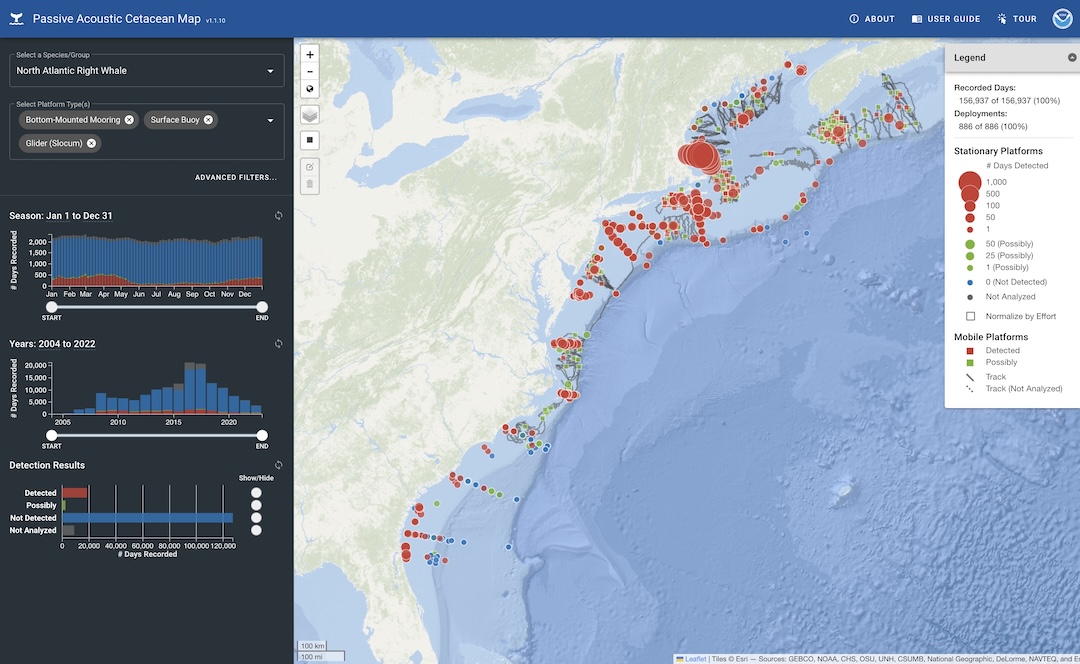
Passive Acoustic Reporting System (PARS)
PARS is a centralized database for gathering and sharing PAM detection data from various government agencies, universities, non-profit organizations, and industry partners. PARS supports collaborative scientific research, management, and public awareness of marine species by combining datasets generated using a variety of PAM methods, instruments, and software.
Visit PARS
Makara Passive Acoustics Database
Makara is a centralized database for managing, sharing, and analyzing passive acoustic data within NOAA Fisheries. Makara is an internal database available only to NOAA employees and contractors with an active NOAA email address, and is not publicly accessible. External partners and data collectors are welcome to contribute passive acoustic detection data for display on PACM using PARS to submit their data instead.
Visit Makara (NOAA Only)
Contact Us
Questions or feedback? Email the NOAA Fisheries Passive Acoustics Team at passive.acoustics@noaa.gov.